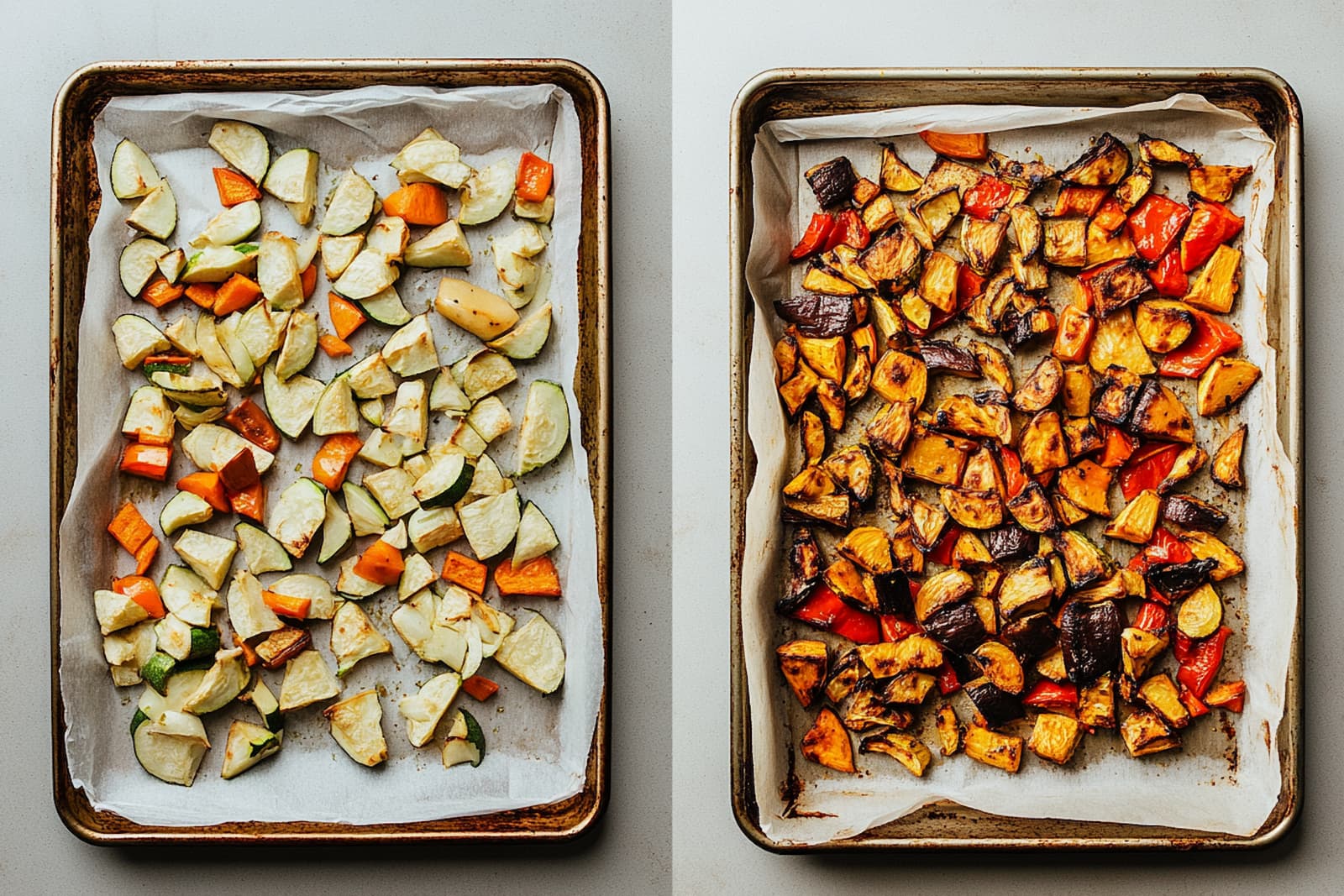
Almost every bland tray of roast vegetables fails at the same point — and that point is not in the recipe, it is on the tray.
There is a moment with roast vegetables where almost everyone gets out. The edges turn brown, a few tips are nearly black, and something in your head says: take it out, it is burning. One minute later it would have started tasting genuinely good.
The reason is the Maillard reaction — amino acids and sugars combining under heat into the flavours we call "roasted". It only gets going properly above roughly 140 °C at the surface. And that is where the real problem sits: as long as water is evaporating out of the vegetable, the surface stays stuck near 100 °C. It cannot brown. It is steaming.
The most common response to pale roast vegetables is to turn the oven up. It rarely helps. When too many pieces sit on one tray, the steam has nowhere to go — the pieces cook each other, whether the dial says 200 or 240 °C.
In our tests one rule of thumb proved useful: leave roughly a finger's width between any two pieces. As soon as the vegetables touch, reach for a second tray. It sounds like more work and it is the single step that reliably makes a difference.
A half-full tray at 200 °C beats a packed tray at 240 °C. Every time.
The second common mistake is salt. Salt draws water out of the vegetable — exactly the water that then prevents browning. With courgette, aubergine and mushrooms it pays to salt only halfway through the roasting time, or to salt beforehand, leave it twenty minutes and pat it dry.
With firm things like cabbage, carrot or pumpkin it barely matters. There the salt can go in from the start.
Too little oil is the third classic. Oil transfers heat from the tray to the surface and makes the browning even rather than patchy. One tablespoon for a whole tray is not enough. Three or four is realistic, and the vegetables should visibly gleam before going in, not merely look damp.
Put those three together — spacing, late salt, enough oil — and you get exactly the dark, brittle leaf edges that the whole dish depends on in the cabbage in the oven.
Nikolas Thiele
Burned seven trays of vegetables for this piece and rescued four.