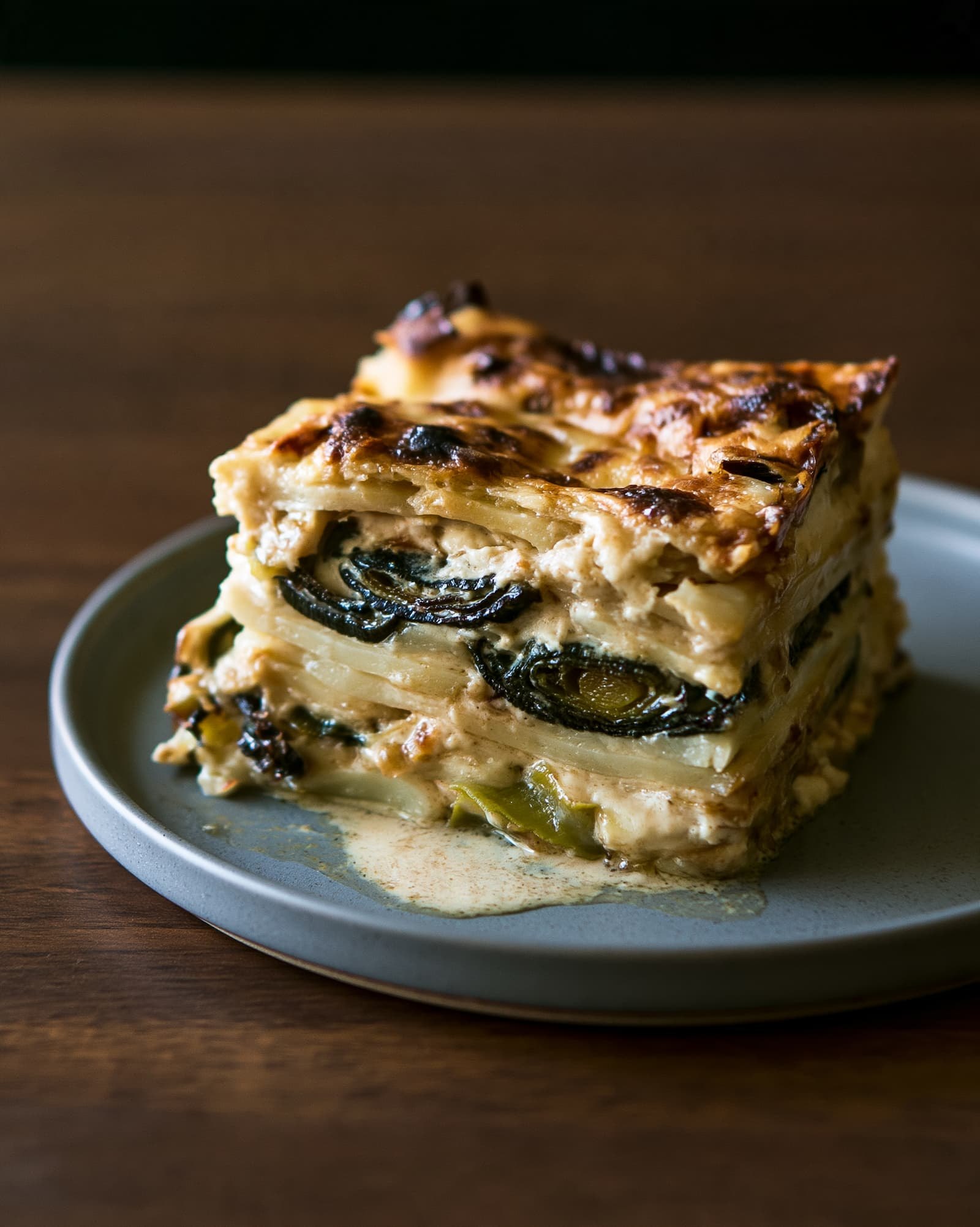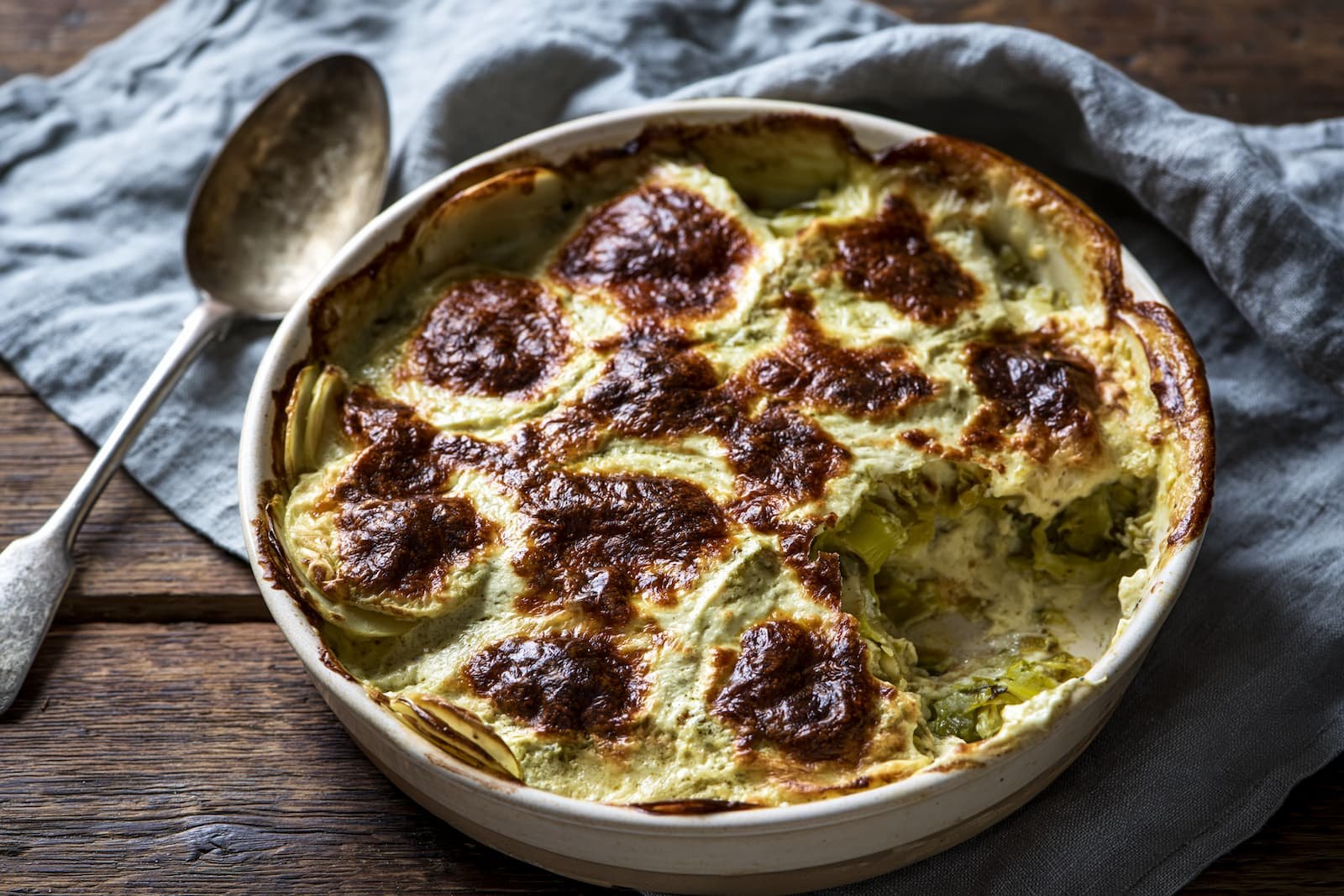
Thin slices, part-cooked in the cream so they bring their own binding. Between them leek, softened for five minutes in the same cream.
A gratin is supposed to be the dish where you pour cream over potatoes and wait. That is exactly how you get the version everyone knows: a lid of cheese on top, slices sitting apart on the plate, and a thin watery puddle at the bottom of the dish. The mistake does not happen in the oven. It happens at the sink.
The starch you rinse away is the only thing that can bind the cream — there is no flour here, no egg, no cornflour. So the slices go into the hot cream unwashed and cook there for five minutes before anything reaches the dish. After that the liquid is already thick and the oven only has to cook and brown. The leek softens in the same cream and brings the bitter edge without which cream tastes of nothing but fat.
Eight ingredients, one dish. Serves 4 as a side or 2 as a main with a salad. The calculator changes the amounts, not the dish: for eight servings use two dishes, or one of 30 × 35 cm. Any deeper than four centimetres and the top is done before the middle is.
Heat the oven to 180 °C conventional, 160 °C fan. Halve a garlic clove, rub out a baking dish of about 20 × 28 cm with it, then grease the dish with the butter.
Peel the potatoes and slice them two to three millimetres thin, on a mandoline or with a sharp knife. Do not rinse them and do not hold them in water.
The slices cling together and your fingers go dull from them. That is the starch, and you need it in a minute.
Put cream and milk in a wide pan, press in the second garlic clove, add nutmeg, salt and pepper, bring to the boil. Halve the leeks lengthways, wash them well, cut into half rings a centimetre wide and let them soften in the cream for five minutes.
Add the potato slices, bring back to the boil and simmer gently for five minutes, lifting them from underneath twice. This step is done when the cream has visibly thickened and leaves a film on the back of a spoon.
From here on lift, do not stir. The slices break more easily than you would think.
Tip everything into the dish and press the surface flat with the back of the spoon until the liquid rises between the slices. Scatter the cheese over the top.
Bake for fifty minutes. It is done when the surface is patchy dark brown — not evenly golden — and a knife goes down to the base without resistance. Let it stand for ten minutes before cutting, or it runs.
Depending on the dish it takes 45 or 60 minutes. The colour decides, not the clock.
The most common mistake is not in the recipe but in almost every instruction beside it: rinsing the potato slices. That washes off the starch, and starch is the only thing in this recipe that can bind the cream — there is no flour, no egg, no cornflour. If the cream stays thin and settles at the bottom, that was almost always it. The second reason is the variety: firm waxy potatoes carry little starch of their own. Something between waxy and floury is the compromise that does both, holds its shape and binds.