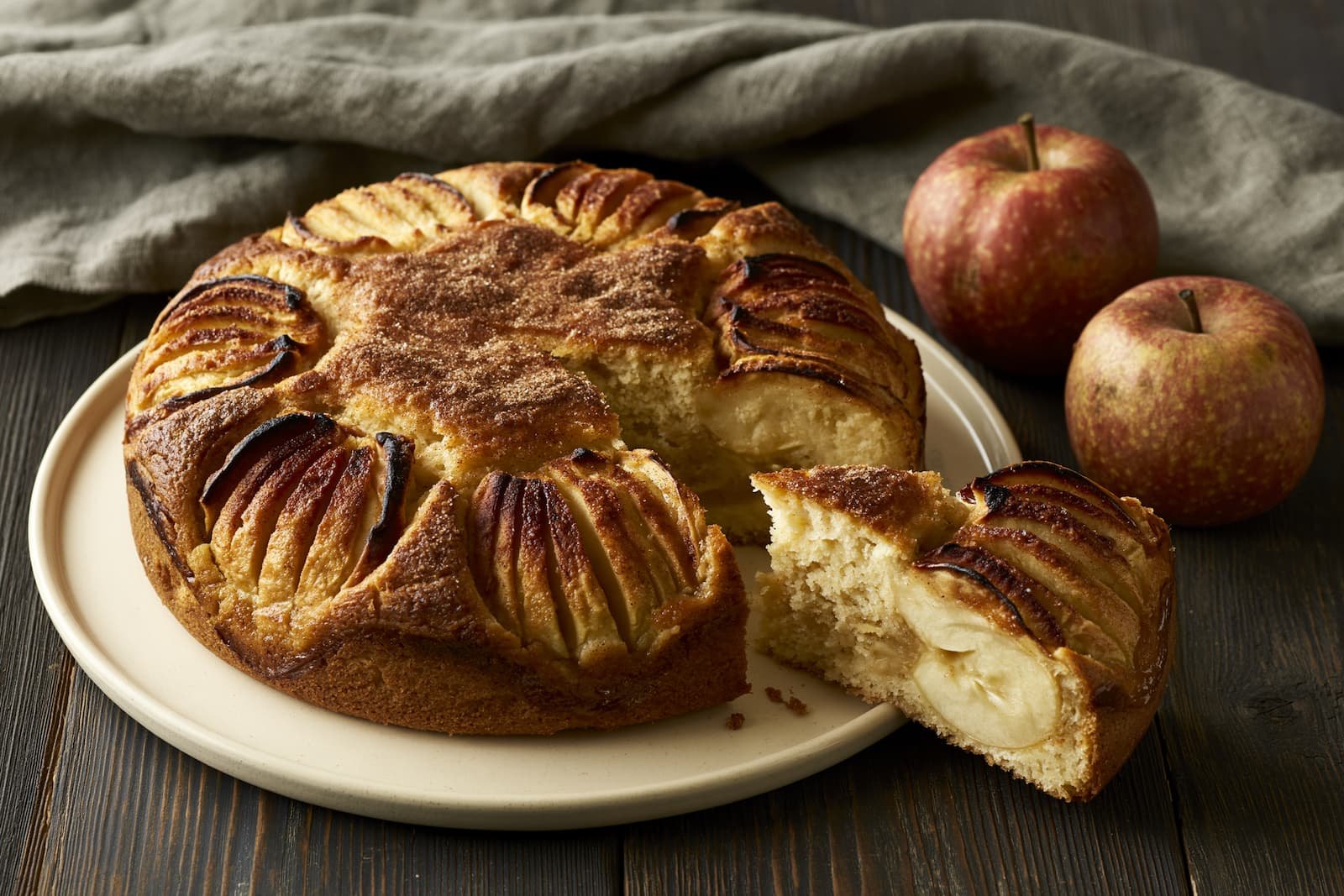
A creamed batter stiff enough to hold apple halves, and apples scored so the juice travels up instead of down. One bowl, one spoon, one tin.
When an apple cake tastes of nothing, people look for the fault in the batter: not enough sugar, not enough butter, the wrong flour. The batter is rarely the problem. The problem is the apple sitting at the front of the shop — sweet, soft, thin-skinned, bred to be eaten raw. In the oven an apple like that gives off water and nothing else.
A baking apple has to do two things: bring acidity and hold its shape. Bramley, Boskoop, Braeburn, Cox, or whatever comes off an old orchard tree. The rest is an ordinary creamed batter, just stiffer than usual so the halves do not slide all the way to the base. They should sink halfway, not all the way.
Eight ingredients, one bowl, one 24 cm springform tin. The calculator changes the amounts, not the tin: at half the quantity you need 18 cm, at double you need two tins. Covered at room temperature it keeps three days and is better on the second than on the first.
Heat the oven to 175 °C conventional, 155 °C fan. Line the base of a 24 cm springform tin with baking paper, grease the side with a piece of the butter and dust it with flour.
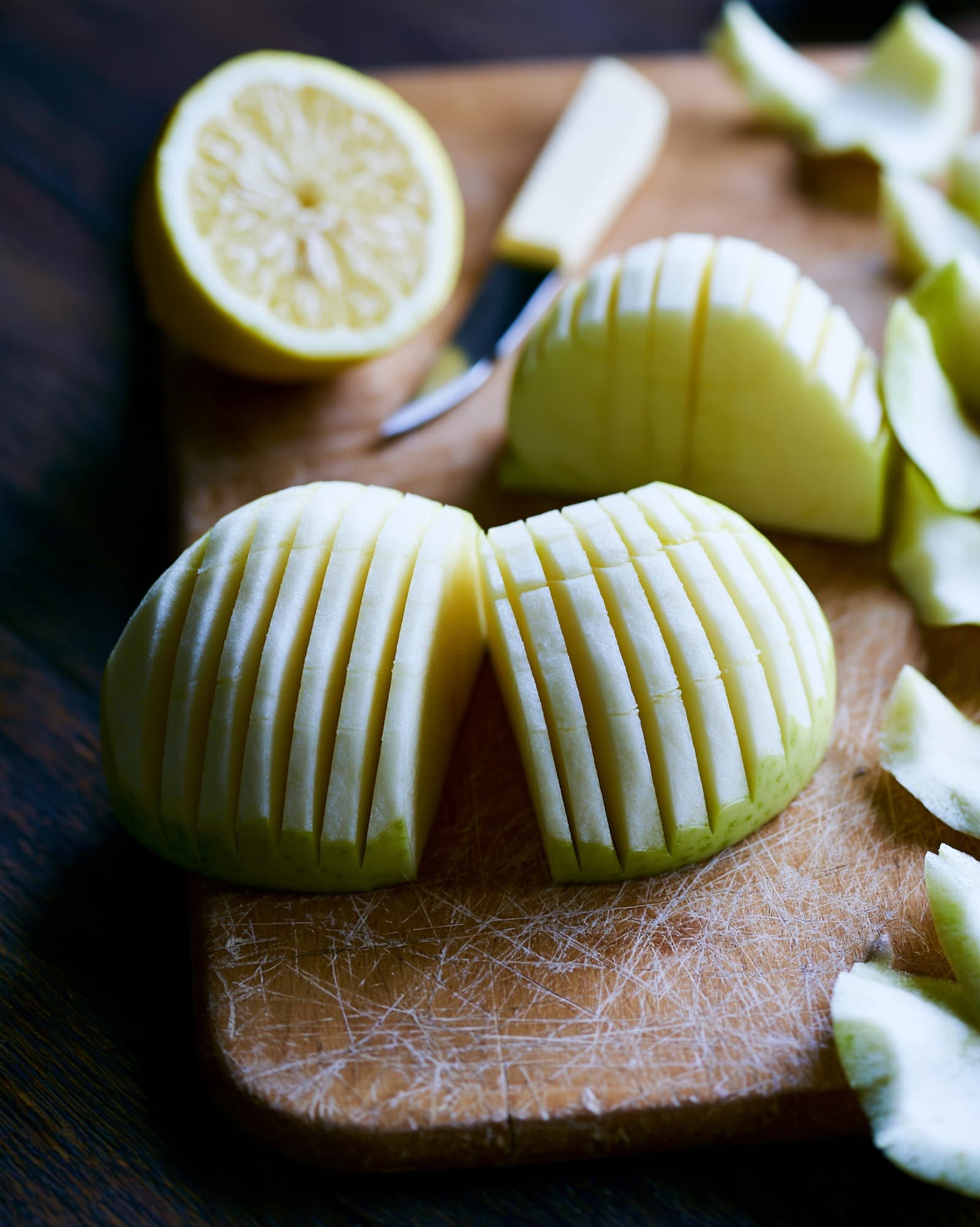
Peel the apples, halve them and scoop out the cores with a teaspoon. Score each half across the curve at intervals of about three millimetres, without cutting through. Sprinkle with the juice of half the lemon.
The cuts look like decoration. They are the reason the cake does not go wet under the fruit — the steam leaves upwards instead of the juice running down.
Beat butter, sugar, the grated lemon zest and the salt in a bowl for four minutes with an electric whisk, until pale and airy. Add the eggs one at a time, beating each in for half a minute before the next goes in.
Room-temperature eggs. Cold ones curdle the mixture, and then the cake stays heavy.
Mix flour and baking powder and fold it in all at once, only until no flour is visible. The batter is ready when it drops heavily off the spoon and does not flow back.
Spread the batter into the tin and level it. Press the apple halves in cut side down, in circles, until they sit about halfway into the batter. Mix the cinnamon with a teaspoon of the sugar and scatter it over.
Bake for fifty-five minutes, testing with a skewer from minute forty-five. The cake is done when the cuts in the apple halves have opened up and the skewer comes out dry. Cool in the tin for twenty minutes, then release the side.
Push the skewer in between two apples, not into one. Inside an apple it is always wet.
If the cake tastes flat and stays wet under the apples, it was not the batter but the variety. Gala, Golden Delicious and Jonagold are eating apples: a lot of water, little acid, little structure. In the oven they fall apart into a pale mush and give their water to the batter — hence the damp band under the fruit, hence the missing flavour. A sharp, firm apple gives off less water, keeps its edges and stands up to 180 grams of sugar. If sweet apples are all you have, the juice of the second lemon half over the cut halves helps. It does not replace the variety, but it rescues the cake.